In 20 seconds
- The problem
- Anyone looking for a perfume faces hundreds of options, opinions without a common criterion and sites that score according to who pays them.
- What we did
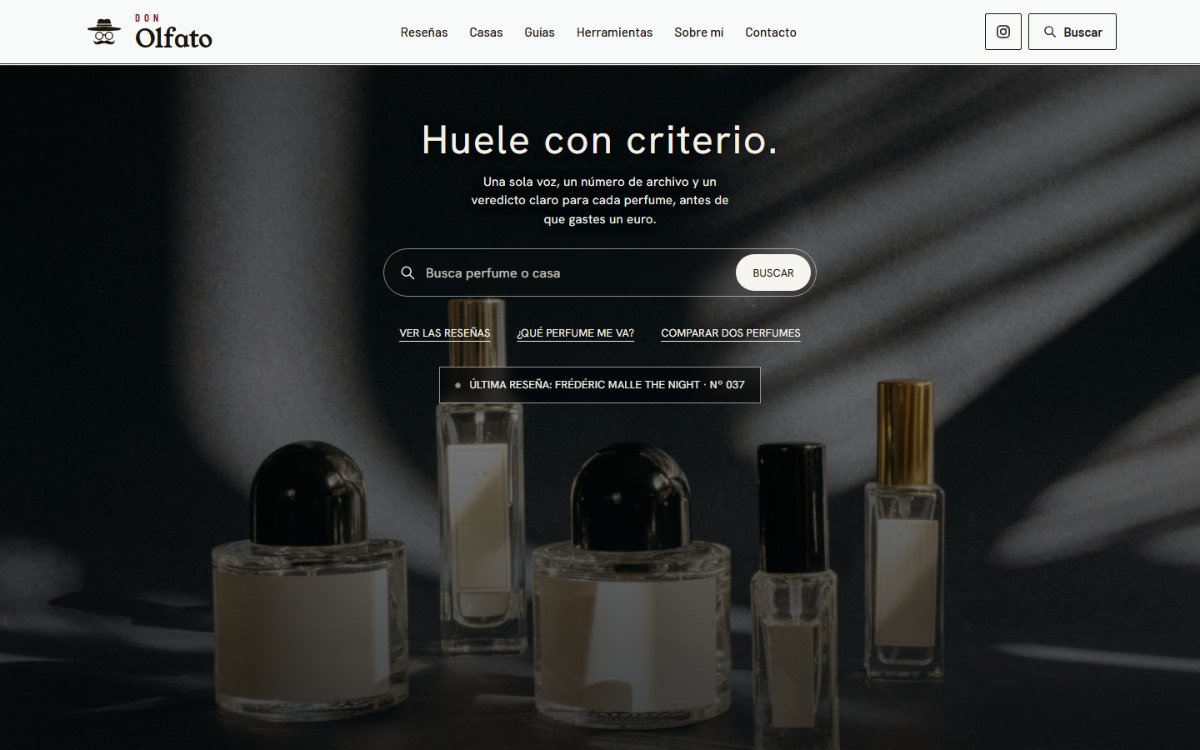
- A site with one voice, a score across five criteria that decides the seal, an archive you can search and filter, guides by occasion and three tools to help decide.
- The result
- A live website with 37 reviews and 14 guides, prepared so that Google and AI assistants understand each review. We are not measuring traffic yet.
01The challenge
Reviewing perfumes without losing the reader’s trust
A perfume cannot be seen or measured in a photo, and most reviews look alike: top, heart and base notes, and a “smells great”. The reader leaves with the same doubts they arrived with.
The first challenge was to give a comparable criterion. With five criteria scored 0 to 10 (opening, evolution, longevity, sillage and value for money), the average decides a seal and every review speaks the same language.
The second was trust. The site contains affiliate links, and that is stated in plain sight: they are always marked and do not change the score or the verdict. The seal is decided by the average, not by the shop that sells it.
The third was keeping a website with hundreds of pages easy to browse: by house, by scent family, by occasion or with search.
02What we did
The decisions behind this case
-
Criterion
A score across five criteria, not an impression
Opening, evolution, longevity, sillage and value for money are scored 0 to 10 and the average decides the seal: Essential, Recommended, With reservations or Not for me. Each review carries its archive number.
-
Voice
One person giving an opinion
Reviews are written in the first person, with public data as support and David’s opinion as the verdict. That way they do not read like a catalogue sheet.
-
Navigation
Four drawers and a scent wheel
The archive opens by type (designer, niche, Arabic and budget) and by scent family, with a search that tolerates typos. Every fragrance lives somewhere easy to find.
-
Tools
Helping people decide, not just read
A twelve-question quiz suggests matching reviews, a calculator compares the real price per millilitre and a comparator pits two fragrances against each other score by score.
-
Search
Every review, prepared for Google and for AI
Each review carries structured data for product, rating and frequently asked questions, and the site has a sitemap, so search engines understand which fragrance it is and what score we give it.
03Method
How we did it, step by step
The process we could build for another review or comparison website.
Define the criterion
What is scored, on what scale and how the score becomes a verdict anyone can understand.
Design the archive
How reviews are grouped (house, family, occasion) so the reader reaches what they need in a few clicks.
Build the templates
A review, a house page and a guide are always generated with the same structure, with structured data and internal links.
Add tools
A quiz, a calculator and a comparator, so anyone in doubt has a way to decide on the site itself.
Publish and maintain
Each new review enters the archive, the sitemap and the lists, without touching the design.
04Apply it
What you can apply to your content website
These ideas work for any site that compares, reviews or recommends.
- Set a visible criterion. If every page is scored the same way, readers learn to read them and trust you more.
- Say so when there is advertising. Mark affiliate links and explain they do not change the score. Transparency protects trust.
- Organise the way people search. By brand, by type, by occasion: ask where someone who does not know you would come in.
- Add one useful tool. A calculator or quiz that settles a specific doubt gets shared and remembered.
- Structure the data. Marking up product, rating and questions helps search engines and AI assistants understand each page.
05Deliverables
What is in place today
- An archive of 37 reviews with a five-criteria score and a verdict seal
- Pages by house and by scent family, with a search that tolerates typos
- 14 guides by occasion, season, value for money and how to choose
- A 12-question quiz, a cost-per-millilitre calculator and a two-fragrance comparator
- Structured data on every review, a sitemap and legal and affiliate transparency pages
06Results
The results
On 15 November 2026, Don Olfato has 37 reviews and 14 guides published on a website with 108 pages in its sitemap. These are figures anyone can check on the site itself.
- 37reviews published (15/11/2026)
- 14guides published (15/11/2026)
- 108pages in the sitemap (15/11/2026)
We are not publishing traffic, Google rankings or affiliate income figures yet: once we can measure them reliably, we will add them here with their date.
07Who this case is for
Who this case is for
This case helps if you want to build a website that reviews, compares or recommends products (fragrances, sports gear, tools, courses) and have readers trust it. A visible criterion, an archive that is easy to browse and tools that help decide make people come back and help Google and AI assistants understand each page.
08Mistakes to avoid when building a review website
Mistakes to avoid when building a review website
- Scoring without a fixed criterion: every review looks like it comes from a different site.
- Hiding affiliate links or letting them decide the score.
- Copying the manufacturer’s sheet instead of giving your own opinion.
- Creating hundreds of pages without a clear way to browse them.
09Questions
Frequently asked questions
Who writes the Don Olfato reviews?
David Rocamonde, in the first person. The scores and verdicts are his; the site organises the archive and calculates the seal from the average.
Do affiliate links change the score?
No. They are always marked and the site explains it. The seal is decided by the average of the five criteria, not by the shop that sells it.
Why not publish traffic or income?
Because we have not measured them reliably yet. We prefer to show what can be checked today, with its date.
Can I have a review or comparison website like this?
Yes. It adapts to your sector: what is scored, how the archive is organised and which tools help decide. Tell us what you would compare and we will tell you what we would set up.
Is this an AuPath business?
No, it is David’s own brand. With AuPath we built the website and use it as an example of what we can set up for a content website.
How many reviews do I need to start?
Fewer than it seems: better a few with a clear criterion and well organised than many with no structure. You grow step by step.
Can a review website be monetised?
Yes, through affiliates or advertising, always telling the reader in plain sight and following the rules. This case includes no income figures.
What should I look after to appear on Google?
A clear structure, original text, structured data on every review and internal links between reviews, guides and tools.